

Planning
Bone density classification from imaging flags the site as needing a compaction-oriented protocol.
i-Fix Clinical planning scenario · Compromised Bone Density
Progressive high-angle thread for controlled compaction in soft bone.
This is a clinical planning scenario — how implant geometry and platform map to this category of case — not a documented individual patient record. Real, consented case documentation lives in Before / After.
01 The clinical challenge
Posterior maxilla or other soft-bone (Type III/IV) sites, where a standard thread design can under-perform on primary stability and the case calls for progressive bone compaction instead.
02 The implant solution
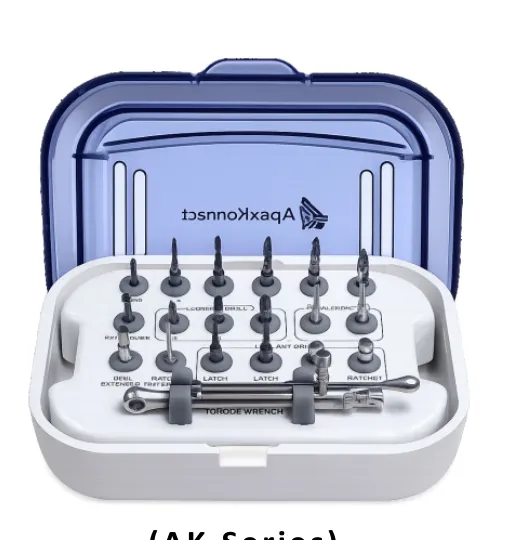
The AK Series (Apex Konnect) has a progressive high-angle thread with varying thread depth and a concave apex, designed for controlled cutting and compaction rather than a single fixed thread geometry.
Full AK Series specification →03 Typical treatment process
A general implant workflow for this case type — individual timelines vary by patient and clinician judgment.
Bone density classification from imaging flags the site as needing a compaction-oriented protocol.
Diameter selection weighted toward the series’ progressive-thread sizes for the available bone.
Under-sized osteotomy relative to implant diameter, letting the progressive thread compact bone on insertion.
Stability at placement determines whether immediate or delayed loading is appropriate.
04 Product & kit
.webp)
05 Key takeaways
Submit documented, consented case photography or planning notes and the clinical team will follow up on publishing it properly — with attribution, not as an anonymous marketing example.